How sewing threads are made: the industrial production process
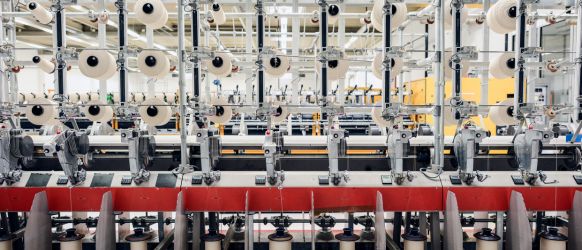
Thread production is a key process in the textile industry, transforming raw fibers into high-quality sewing and embroidery threads for diverse applications. The manufacturing process includes essential steps such as cleaning, drawing, twisting, and plying to create strong and consistent single yarns. Advanced quality control, dyeing, lubricating, drying, and finishing techniques ensure durability, color consistency, and optimal performance, efficient make-up, labeling, packaging, and storage processes further support scalable production and reliable supply for global textile markets.
The manufacture of sewing threads and embroidery threads is a complex process involving a large number of individual production steps on various machines and production facilities. The production diagram at the end of this chapter provides an overview of the production of the most important types of sewing and embroidery threads at AMANN.
In contrast to sewing, which is generally labour-intensive due to the operation of sewing machines, sewing thread production primarily requires a high level of machine use. State-of-the-art, largely computer-controlled and fully automated production facilities determine the manufacturing process.
Production staff are mainly needed for feeding and cleaning the machines. Production control is also fully automated in most process steps. Faults are reported by detectors and rectified by staff. Many production steps have a lead times. Unlike in clothing production, for example, where calculations are made in minutes, in sewing thread production there are lead times of several hours, and in some cases even days, at certain stages. Optimal production planning and control is therefore particularly important for sewing thread production.
Today, sewing thread production involves the processing of synthetic or semi-synthetic preliminary products. With a few exceptions, pure natural fibres are now of little significance. Cotton thread is the most important representative here and has therefore been included in the production diagram at the end of the chapter and in the descriptions of the production steps. The production lines for the individual types of sewing thread (spuns, core spuns, continuous filaments, textured continuous filaments, etc.) differ in terms of the process chain and selected manufacturing steps that are specifically required for individual types of sewing thread. In addition to the production diagram, the most important process steps in sewing thread production are described below.
Quality control
Quality control, which is carried out after each important production step, is of great importance in the process chain. Depending on the production stage (raw yarn, raw thread, finished thread), various quality criteria (linear density, strength, fibre purity, etc.) are checked and systematically recorded on the basis of strict production specifications. Only those batches that meet all criteria are released for further processing. The data collected is included in the weekly and monthly quality reports, which provide precise information about the quality level and any trends or problems.
This complex quality control process is necessary to ensure a consistently high level of quality across all batches and to comply with agreed delivery specifications, for example with customers in the automotive industry. Any quality defects cannot usually be corrected in the finished product and must therefore be identified and eliminated at an early stage.
In addition to quality control in the laboratory, AMANN therefore carries out extensive quality monitoring during production. In some cases, machines perform the monitoring function for individual quality criteria fully automatically, e.g. through thread monitors on the twisting machines or electronic thread sensors on the winding machines. In addition, quality control specialists in production continuously monitor the manufacturing conditions, thereby ensuring that there are no defects in the goods.
In addition to technological quality control, it is important to check the dyeing process to ensure that all batches of a colour are exactly the same. This requires both the experienced eye of the dyer and the use of colour measuring devices with modern testing technology.
Production of single yarn
Yarns are preliminary products in the manufacture of thread. Some are produced by sewing thread manufacturers, others by preliminary suppliers – spinning mills and chemical fibre producers. The principle of yarn production is identical regardless of the raw material used for the respective yarn types. Analogous to the construction types, there are the following different yarn types:
The raw materials are cotton fibres or synthetic cut staple or schappe spun fibres, which are delivered in compressed bales. The loose fibre material is processed into roving in various steps:
- Loosening and cleaning
- Arranging and parallelising the fibres
- Sliver formation
- Drawing out
- Pre-spinning to form roving
At AMANN, both rovings made from cut staple fibres and schappe spun fibres are processed. When processing cut staple fibres, the length of the fibres is identical to the average staple length of cotton fibres, meaning that the roving can be processed on ring spinning machines in what is known as three-cylinder spinning.
The fibres are stretched and doubled several times to produce a fibre yarn of the desired fineness. Pre-spinning and yarn twisting are carried out on ring spinning machines in the three-cylinder spinning process.
Cotton yarns are spun on ring spinning machines in three-cylinder spinning mills. The yarn is twisted on the ring spinning machine.
For core yarn production, raw material made of continuous filament material must be combined with a covering of cut staple fibres. The manufacturing principle for the covering is similar to that for spun yarns. The fibre material is delivered in pressed bales and processed into roving. The spinning process on the ring spinning machine then combines the covering and the continuous filament core. Finally, the yarn is twisted. The core yarn is the starting product for the core spun thread.
Continuous filament yarn is used as the raw material, which is sourced directly from the chemical fibre industry. This raw material consists of fine, parallel individual filaments that are only slightly twisted or twisted for protection.
The number of individual filaments varies greatly and depends primarily on the overall fineness of the material. In some cases, continuous filament bundles with up to 200 individual filaments are used. The required yarn twist is only applied shortly before the yarn is plied and twisted on the twisting machine.
Polyester or polyamide continuous filaments are used as the starting material, which are further processed into bulk yarns through texturing. There are various texturing processes. The false twisting process is generally used for this application of bulk yarns. In this process, the smooth filament, consisting of numerous individual filaments, is passed through a heated zone, at the end of which a high-speed twisting device produces the desired twist. The twist is fixed by heat treatment and subsequent cooling. The yarn is then untwisted again, but the puckering remains and creates the familiar bulk effect.
In braiding, yarns are intertwined on a horizontal plane. This is done by rotating 6 or 8 of a total of 12 or 16 bobbins clockwise and 6 or 8 counterclockwise around a common axis. The clapper path describes a wave pattern, as the clappers have to avoid each other. The braided yarn produced in this way is then wound onto a so-called tambour. The yarn has a tubular shape, is hollow on the inside and lies flat. As the yarn has no twist, it must be pulled off by rolling. Pulling it overhead, as with standard sewing threads, would cause the braided yarn to twist, resulting in an unattractive seam. Braided yarn is therefore unrolled throughout the entire process chain up to the sewing machine.
Cleaning
Spun yarns and core yarns contain thick and thin spots, which arise during the processing of the fibres in the spinning mill and cannot be completely avoided. These yarn defects are caused by, among other things, fibre fly, impurities and slubs in the spinning mill and are removed during cleaning on winding machines. At the same time, this process connects the delivered raw yarn into larger, knot-free lengths by splicing the yarn ends together (with air swirling).
The splice points are significantly thinner than a knot (approx. 40%) and ensure acceptable strength at the splice point. A splice point in the yarn has no adverse effect on the sewing performance of the subsequent yarn. Sensors on the winding machines check the yarn purity and compare the detected thick and thin spots with the specification. Thick spots that are thicker than a splice, for example, are automatically cut out and replaced by a splice. The result is purified preliminary products that provide maximum running length for the subsequent production step and thus form the basis for knot-free sewing thread quality.
This step is not necessary for raw yarns made from filament material. Firstly, filament raw yarns do not contain any impurities. Secondly, filament yarns are already supplied in long lengths by the chemical fibre manufacturer.
Plying
Twisted yarns consist of two or more yarns that are brought together during the plying process, thus preparing them for the subsequent twisting process. Depending on the type of sewing thread, plying is carried out on a separate machine or in conjunction with the twisting process. Spun yarns and core yarns are plied in a separate production step and given a protective twist to prevent the individual yarns from shifting during transport to the next machine. The protective twist should not be confused with the twisting achieved by the subsequent twisting process. In the case of continuous filament yarns, plying and twisting can be carried out on a single production line.
Twisting
Twisting is the process of twisting yarns together to form a thread. The plied yarns are twisted around their longitudinal axis, thereby binding them tightly together. The twist is created by a rapidly rotating spindle. Depending on the direction of rotation of the spindle, there are S-twisted and Z-twisted yarns. The off-winding speed and spindle speed determine the number of twists in the thread. Today, the twisting process is used almost exclusively to produce direct or single-stage threads, i.e. several yarns are twisted together in a single operation. Double or multi-stage threads, which are hardly used today, require two or more successive twisting operations.
The lead times for the twisting process are very long. The finest continuous filament yarns, which are processed by the twisting machine in correspondingly large lengths, have a lead time of twelve days, for example.
Single sewing threads are also twisted in order to obtain a uniform and stable preliminary product. The term ‘“uptwisting” is more understandable here than ‘twisting’, as only one yarn is twisted around its longitudinal axis instead of connecting different yarns with each other by twisting.
On twisting machines for continuous filament yarns, the filament threads undergo both yarn twisting and final thread twisting. Pre-wound continuous filament yarn is fed into the twisting machines, where it is first twisted in the S direction, then folded and twisted in the Z direction. This is a particularly effective manufacturing process that is mainly used for filament material.
Drawing and setting
Synthetic yarns and threads usually need to be drawn and set in order to achieve the desired level of shrinkage and stretch properties. This process plays an important role in the quality of sewing threads and embroidery threads, especially in terms of sewing performance and appearance. During drawing, the thread is pulled under tension and rewound, resulting in drawing and stretch adjustment. This reduces the existing stretch of the thread. Depending on the type of sewing thread and embroidery thread, the drawing and fixing process is carried out at different positions within the process chain and using different methods.
Core spun and spun threads are wound under tension onto so-called drawing spools, which are then fixed in an oven on a setting cart. The effect of hot air at high setting temperatures permanently stabilises the drawing and thus the reduction in elongation achieved. Sewing threads treated in this way retain their stretch and shrinkage properties up to this temperature range during subsequent use.
Sewing threads made of continuous filament material are drawn by pairs of fast-running cylinders, one of which is heated. The use of the ring tube facilitates the drawing process. The ratio of the different cylinder speeds determines the degree of drawing. Continuous filament yarns are not usually thermally set afterwards.
Dyeing
For this production step, the threads must first be rewound onto dyeing spools. The hollow spindles are perforated to allow the dye bath to pass from the inside to the outside and vice versa. In addition, a suitable winding structure and controlled tension during rewinding are important for the subsequent dyeing result. The aim is to achieve uniform colouring of the sewing threads and embroidery threads, regardless of their position (outside or inside) on the dyeing spool.
Polyester sewing threads and embroidery threads are dyed using the so-called HT (high temperature) process. Disperse dyes are used for dyeing. Important dyeing parameters are pressure, temperature and the bath liquor ratio. Dyeing takes place in a closed circuit on modern dyeing equipment. The colour formula is compiled with the aid of a computer. In the so-called mixing room, the individual dyes and dyeing auxiliaries are prepared according to exact specifications and mixed with water in dyeing kiers. The dye bath is fed through a pipe system to the individual dyeing kirtd in the dye house. These have different capacities ranging from approx. 10 to 700 kg. Polyester threads are dyed at approx. 135°C and a pressure of four to six bar for approx. 60 minutes. The colour shade achieved is checked immediately after the dyeing process so that any colour deviations can be compensated for immediately by re-dyeing. Coarser yarns sometimes have to be dyed twice to achieve optimal colour dye penetration and to avoid the occurrence of so-called undyed spots at the crossing points of the yarn.
The choice of dyeing process is primarily determined by the raw material used for the sewing thread. Cotton and polyamide, for example, require a different process than polyester. In the case of polyester/cotton core spun thread, the combination of polyester and cotton as raw materials requires two dyeing processes to be considered. In a single process, but in two consecutive steps, the polyester is dyed first, followed by the cotton.
Pure cotton yarns are often dyed in hanks and require specially designed dyeing equipment. Cotton yarns are usually dyed using reactive dyes. However, substantive and indanthrene dyes can also be used for special applications. For a small number of polyester/cotton core spun yarn dyeings, AMANN uses substantive dyes to achieve the desired used look (washed-out appearance) in the denim sector.
Optical brighteners are sometimes used to dye white, neon colours and light, delicate pastel shades. This allows UV light from the invisible spectral range to be converted into visible light and reflected. This effect gives optically brightened colours a kind of ‘luminosity’ that is particularly noticeable under black light. The brownish-yellow natural colour of raw cotton is unsuitable for such colours and must therefore be removed by bleaching beforehand.
To create a new sewing thread or embroidery thread colour, the dyeing laboratory requires a flat, non-transparent colour sample (usually a fabric sample). The sample colour is measured using a colour measuring device and displayed as a reflection curve. The dyeing recipe software calculates various recipes from the specified dyes, from which the dyer selects the best one based on quality and economic considerations. The colour yield of a recipe is first checked using a laboratory dyeing test. If necessary, the recipe is adjusted and, if it is approved, it is recorded in the colour archive and released for production.
AMANN attaches particular importance to the environmental compatibility of its dye houses. Through the use of efficient systems and careful monitoring, AMANN has been able to significantly reduce its overall consumption of primary energy. Ongoing process optimisation in the dye houses has led to a considerable reduction in the consumption of fresh water and minimised the use of dyes and dyeing auxiliaries. All dye houses have a closed water cycle.
AMANN operates full-scale biological-chemical wastewater treatment plants in order to comply with local environmental regulations. Their capacity ranges from 500 to 1,000 m3 of wastewater per day. The treated wastewater is continuously monitored at the outlet into the local sewage system to ensure compliance with strict discharge parameters for BOD (biological oxygen demand), COD (chemical oxygen demand), proportion of dissolved suspended solids, pH value and temperature. In addition, samples are taken and analysed regularly by the local environmental authorities. AMANN thus makes a significant contribution to environmental protection.
Lubricating (Finishing)
Sewing threads and embroidery threads must be lubricated, i.e. coated with a lubricant, to ensure optimum sewing performance. Lubrication consists of a combination of silicones, paraffins, waxes and antistatic agents. The exact composition is the secret of every sewing thread manufacturer. The right formula for each product is compiled on the basis of many years of experience and numerous test series.
The lubricant is applied in the dyeing machines immediately after the dyeing process or after dyeing on separate lubricating machines. The selection of the appropriate process is mainly determined by the sewing thread's linear density and the sewing thread type. When finishing the threads in the dyeing machines, it must be ensured that the entire dyeing spool is evenly rinsed with the lubricant so that the goods are finished perfectly (i.e. also inside the dyeing spool). When finishing on separate machines, the thread is finished individually by means of fine dosing using computer-controlled pumps.
The lubricant application is usually approx. 2 to 4%, i.e. the lubricant weighs 2 to 4% of the total weight of the sewing thread. A precisely measured and even lubricant application is important to guarantee the required performance.
The main functions of lubrication for sewing threads and embroidery threads are:
- Improving gliding properties
- Improving abrasion resistance
- Needle cooling
- Reducing the tendency to static charge
Drying
The dyed and partially finished goods must be drained and dried before they can be sent on to the next stage of production. After initial drainage, the goods are tumble dried in a high-frequency dryer or in pressure dryers, followed by hot air treatment.
Special finishing process
Special applications or end products often require special additional finishing or finishing steps. These are inserted at various points in the manufacturing process to achieve specific effects and properties.
During gassing or scorching, protruding fibre hairs are burned off. This finishing process smooths the surface of sewing threads made from spun threads. This gives the thread a higher sheen. A gas flame (hence the term ‘gas treatment’) or an electrically heated burner is used for burning. Due to the high winding speed, it is not possible for the material being processed to burn. Only protruding fibre ends are burned, which are then immediately removed by an suction system.
Cotton threads are mercerised before dyeing. During mercerisation, the cotton is treated with caustic soda under tension, causing the fibre to swell and change its cross-section. Mercerisation is usually carried out on the hank material. This additional production step is necessary to give the cotton yarns a silky sheen, increase their tear resistance and improve their dye absorption capacity.
Polyester/cotton core spun threads and pure cotton threads are sometimes polished or dressed to give them a smoother, more uniform surface and at the same time increase their abrasion resistance. In this finishing process, the dyed yarns are dipped in starch or a synthetic wax preparation and then brushed. This brushes any protruding fibres in one direction close to the yarn surface. This finish also has advantages in terms of sewing, as the more closed yarn surface provides greater resistance to untwisting.
In this special treatment, an additional synthetic preparation for film formation (known as a bonding substance) is applied after the dyeing process. The sewing threads are immersed in a bath containing the bonding substance and then passed through a squeezing mechanism that removes any excess bonding material. A directly connected heating channel then ensures that the bonding is condensed or dried.
The bonding substance in the immersion bath is applied as an aqueous dispersion or as a solvent-based product. Depending on the choice of bonding substance, the sewing threads must then be additionally lubricated to ensure the usual sewing performance.
In addition to this conventional and most commonly used type of bonding, there are other methods: for polyamide filament yarns, for example, bonding can be based on treatment with acid. The bonding effect is achieved by dissolving the polyamide filaments under the influence of acid.
Bonding, colloquially referred to as ‘gluing’, ensures better cohesion between the single yarn elements of a thread. The bonding substance creates a special bond between the threads on the surface of the sewing thread, resulting in a better thread bond. Bonded sewing threads are therefore easy to recognise: on the one hand, they are stiffer than normal sewing threads due to the additional preparation (this is immediately apparent when pulling the product off the spool), and on the other hand, these sewing threads are difficult to untwist. You can clearly feel a resistance, which is due to the effect of the bonding.
This special treatment is generally only considered for synthetic filament sewing threads in the coarser ticket range from ticket 60 onwards. For filament yarns, which have a less effective twist due to the smooth surface of the individual threads, this preparation is necessary and useful for special applications. Classic areas of application are seams that cause the sewing thread to twist or the so-called twist shift during sewing, such as multidirectional seams on airbags or zigzag seams on sails (twisting and turning effect of the sewing thread depending on the direction of the zigzag stitch).
For some applications, e.g. shoes or outdoor textiles, an additional hydrophobic finish of the sewing thread is useful. Hydrophobically finished sewing threads can significantly delay water penetration at the seams. However, waterproof seams cannot be achieved by using hydrophobic sewing threads. The hydrophobic finish is usually applied on separate finishing machines together with the standard finish.
The AMANN range includes a wide variety of products with a water-repellent finish.
For seams that are exposed to intense and prolonged sunlight, e.g. sails, awnings, conservatory shading, additional UV protection may be required for the polyester sewing threads used. One option is UV protection via the finish, although the potential of this effect is often overestimated. For UV protection, the standard preparation is supplemented with a UV blocker. This finish is applied as described above.
Sewing thread finishes usually contain silicones. If these cause problems in the final application, e.g. in filter production for paint shops or in clean room production, sewing threads can be finished with a silicone-free finish by changing the finish recipe. There are various options for this, depending on the field of application. Some silicone-free finishes contain paraffins. If these are also undesirable, it is possible to finish sewing threads with aliphatic esters that are both silicone-free and paraffin-free.
Make-up labelling
In the winding department, the finished threads are wound onto various types of packaging (cops, cones, foot spools, king spools, etc.). Modern winding machines ensure optimal, identical winding. Today's machines are fully automatic, i.e. the empty tube is inserted and wound automatically. The length and quality of the sewing thread are also checked and monitored.
During labelling, the labelling data is either printed directly onto the spools or onto labels, which are then affixed to/inside the spools. Labelling identifies the products with important product data such as product description, label number, sewing thread raw material, packaging length, colour and batch number. The batch number is particularly important for the automotive industry in order to ensure flawless product traceability. The items are now also marked with barcodes on the cartons, which provide information about the item, colour and batch number.
Packaging and storage
Depending on the type of packaging, the goods are packed in appropriate boxes. Supported in part by modern packaging systems that fold and present the boxes, employees fill the boxes. This method of working automatically performs a final visual quality check. The choice of packaging sizes and thread units within the packaging is tailored to market requirements. The packaging sizes partly determine the sales unit.
In the case of cops, for example, one sales unit (one box) contains ten cops. Single cops are usually not delivered. In the case of larger make-ups, such as cones, the single cone is the sales unit.
The finished goods are stored in central warehouses. AMANN's central warehouse in Erligheim, for example, has a fully automated high-bay warehouse with a capacity of approx. 900 tonnes or 85,000 standard containers.
Due to the variety of raw materials and the different manufacturing and finishing processes, it is not possible to make a general statement about the optimal storage of AMANN sewing and embroidery threads. However, extreme storage conditions (temperature, humidity, sunlight, etc.) should be avoided in order to maintain product quality. The combination of several of these factors may, under certain circumstances, have a negative impact on the quality of the sewing and embroidery threads. Under normal storage conditions, there are no known adverse effects on the quality of AMANN sewing and embroidery threads.
If you count all the items in the AMANN range and take into account every possible colour and packaging size, you arrive at the impressive figure of approximately 45,000 different items.
45,000 items that must be stored in the right quantities so that they can be delivered in full and immediately after an order is received. This is undoubtedly a challenging task, which AMANN can only fulfil through precise production planning, early market information and a willingness to invest heavily.
Production diagram
In the following, you can find a production diagram for AMANN core spun threads and spun threads.