Sewing thread numbering explained: Tex, Nm, denier and ticket numbers
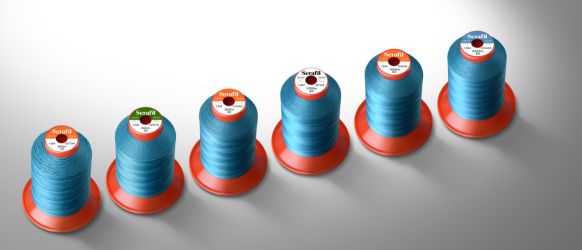
Thread numbering is a crucial concept in the textile industry, defining the thickness, strength, and application range of sewing and embroidery threads. Various textile numbering systems and fine grade specifications are used globally to ensure consistency and comparability across materials. Ticket numbers provide a practical reference for selecting the right thread for specific uses, while yardage indicates the length and efficiency of thread on a spool. Understanding thread numbering helps optimize material selection, production processes, and overall product performance in textile manufacturing.
Textile numbering systems
The linear density of textile fibres, filaments, yarns, threads, and similar materials is expressed as a ratio of weight to length. Various numbering systems are used internationally, depending on the defined reference value. As a result, these systems can still differ today between raw materials and countries, which may make it difficult to compare linear densities directly. It is therefore important to have a thorough understanding of the existing numbering systems and how they are converted. In principle, a distinction is made between the fixed-length system and the fixed-weight system.
In the case of fixed length system, the weight is fixed and the thread length variable, i.e. the length of the sample is divided by a constant weight, e.g. 1 g.
Formula: Count (by length) = length / weight
The following rule applies when using this system: The higher the count, the finer the thread. This means that the fixed length system is inversely proportional.
Nm (metric count) = length (m) per 1 gram (g)
Example: Nm 10 means that 1 g of a sample is 10 m long.
NeB (British cotton count) = Length (m) per 0.59 g
Example: NeB 10 means that 0.59 g of a sample is 10 m long.
Historically based on English units of measurement: NeB indicates how many hanks (ply) of 840 yards (768.1 m) each weigh 1 lb (English pound = 453.6 g).
In the fixed-weight system, the thread length is fixed while the weight varies. This means that the weight of a specific thread sample is divided by a constant length, for example 1,000 m.
Formula: Count (by weight) = weigth / length
The following rule applies when using this system: the lower the count, the finer the thread. This means that the fixed-weight system is directly proportional.
Tex = Weight (g) per 1,000 m
Example: 10 Tex means that 1,000 meters of a sample weigh 10 grams.
Dtex (decitex) = Weight (g) per 10,000 m
Example: 10 dtex means that 10,000 meters of a sample weigh 10 grams.
Td (Titer denier) = Gewicht (g) pro 9.000 m
Example: 10 Td means that 9,000 m of a sample weighs 10 g.
In 1967, the various linear density indicators (Nm, NeB, Td) were officially replaced by the internationally established Tex system, which is now valid and mandatory for all fibres, semi-finished products, yarns, threads, and related areas, regardless of fibre type. Today, the Tex system is the most frequently used textile numbering system and is used by all partners in the global textile chain worldwide.
At the same time, however, other linear density indicators are still in use. Names that have been established over many years remain familiar and cannot easily be replaced through standardisation. One example is tights, which are still classified using the denier system (denier, “Den”). This well-known and widely recognised indicator will most likely continue to be used in the future in order to avoid unnecessary consumer confusion that could arise from switching to a standardised system. There are also historical particularities in the linear density designation of sewing and embroidery threads, known as ticket numbers, which are discussed in the following section.
The following tables present formulas for converting between different numbering systems, and a comparison table illustrates the linear densities used in practice. It should be noted that the values apply to the yarn itself, while ply is not taken into account.
| Known is | Seeking for | |||||
|---|---|---|---|---|---|---|
| Linear density | Abbreviation | Nm | NeB | Tex | dTex | Td |
| Metric count | Nm | - | Nm x 0.59 | 1,000 : Nm | 10,000 : Nm | 9,000 Nm |
| British cotton count | NeB | NeB : 0.59 | - | 590 : NeB | 5,900 : NeB | 5,310 : NeB |
| Tex | Tex | 1,000 : Tex | 590 : Tex | - | Tex x 10 | Tex x 9 |
| Decitex | dTex | 10,000 : dTex | 5,900 : dTex | dTex : 10 | - | dTex x 0.9 |
| Titer denier | tD (den) | 9,000 : Td | 5,310 : Td | Td : 9 | Td : 0.9 | - |
| Example | 50 Tex | 1,000 : 50 Tex = 20 NeB | 590 : 50 Tex = 11.8 NeB | - | 50 Tex x 10 = 500 dTex | 50 Tex x 9 = 450 Td. |
| Nm | NeB | Tex | dTex | Td | Thread length per kg |
|---|---|---|---|---|---|
| 1 | 0.59 | 1,000 | 10,000 | 9,000 | 1,000 m |
| 2 | 1 | 500 | 5,000 | 4,500 | 2,000 m |
| 3 | 2 | 333 | 3,333 | 3,000 | 3,000 m |
| 4 | 2 | 250 | 2,500 | 2,250 | 4,000 m |
| 5 | 3 | 200 | 2,000 | 1,800 | 5,000 m |
| 6 | 4 | 167 | 1,667 | 1,500 | 6,000 m |
| 7 | 4 | 143 | 1,429 | 1,286 | 7,000 m |
| 8 | 5 | 125 | 1,250 | 1,125 | 8,000 m |
| 9 | 5 | 111 | 1,111 | 1,000 | 9,000 m |
| 10 | 6 | 100 | 1,000 | 900 | 10,000 m |
| 11 | 6 | 91 | 909 | 818 | 11,000 m |
| 12 | 7 | 83 | 833 | 750 | 12,000 m |
| 13 | 8 | 77 | 769 | 692 | 13,000 m |
| 15 | 9 | 67 | 667 | 600 | 15,000 m |
| 18 | 11 | 56 | 556 | 500 | 18,000 m |
| 20 | 12 | 50 | 500 | 450 | 20,000 m |
| 25 | 15 | 40 | 400 | 360 | 25,000 m |
| 30 | 18 | 33 | 333 | 300 | 30,000 m |
| 35 | 21 | 29 | 286 | 257 | 35,000 m |
| 40 | 24 | 25 | 250 | 225 | 40,000 m |
| 45 | 27 | 22 | 222 | 200 | 45,000 m |
| 50 | 30 | 20 | 200 | 180 | 50,000 m |
| 55 | 32 | 18 | 182 | 164 | 55,000 m |
| 60 | 35 | 17 | 167 | 150 | 60,000 m |
| 65 | 38 | 15 | 154 | 138 | 65,000 m |
| 70 | 41 | 14 | 143 | 129 | 70,000 m |
| 75 | 44 | 13 | 133 | 120 | 75,000 m |
| 80 | 47 | 13 | 125 | 113 | 80,000 m |
| 85 | 50 | 12 | 118 | 106 | 85,000 m |
| 90 | 53 | 11 | 111 | 100 | 90,000 m |
| 95 | 46 | 11 | 105 | 95 | 95,000 m |
| 100 | 59 | 10 | 100 | 90 | 100,000 m |
| 105 | 62 | 10 | 95 | 86 | 105,000 m |
| 110 | 65 | 9 | 91 | 82 | 110,000 m |
| 115 | 68 | 9 | 87 | 78 | 115,000 m |
| 120 | 71 | 8 | 83 | 75 | 120,000 m |
| 125 | 74 | 8 | 80 | 72 | 125,000m |
| 130 | 77 | 8 | 77 | 69 | 130,000m |
| 140 | 83 | 7 | 71 | 64 | 140,000m |
| 150 | 89 | 7 | 67 | 60 | 150,000m |
| 160 | 94 | 6 | 63 | 56 | 160,000m |
| 170 | 100 | 6 | 59 | 53 | 170,000m |
| 180 | 106 | 6 | 56 | 50 | 180,000m |
| 190 | 112 | 5 | 53 | 47 | 190,000m |
| 200 | 118 | 5 | 50 | 45 | 200,000m |
| 210 | 124 | 5 | 48 | 43 | 210,000m |
The comparison table was compiled in accordance with DIN 60 905. For practical purposes, some values have been rounded up or down.
Linear density specifications for sewing and embroidery threads
According to the global standard, the linear densities of sewing and embroidery threads are expressed in Tex. At the same time, linear density is still often given in Nm. This is because the ticket numbers of sewing and embroidery threads are based on this length system, and many technicians are still more familiar with it.
In practice, however, two different indications are used: either the final linear density or the single linear density. In order to compare sewing threads, it is important to know the number of plies. Ideally, the ply is stated together with the linear density:
- In the Tex system, this is indicated using a multiplication sign and the corresponding number of plies, for example 10 tex × 3. This means that the sewing thread consists of three yarns, each with a linear density of 10 tex. The resulting total linear density is 30 tex (1,000 m of a single yarn weigh 10 g; 1,000 m of the thread weigh 30 g).
- In the Nm system, this is indicated using a slash and the corresponding number of plies, for example Nm 120/3. This means that the sewing thread consists of three yarns, each with a linear density of Nm 120. The resulting total linear density is Nm 40 (1 g of a single yarn has a length of 120 m; 1 g of the thread is 40 m long).
Please refer to following examples:
| Linear density specification sewing thread | Final linear density specification (thread) | No. of piles (yarn) | Weight and length of yarn | Weight and length of thread |
|---|---|---|---|---|
| 10 Tex x 3 | 30 Tex | 3 | 10g/1,000 m | 30g/1,000 m |
| 15 Tex x 2 | 30 Tex | 2 | 15g/1,000 m | 30g/1,000 m |
| Nm 120/3 | Nm 40 | 3 | 120 m/1 g | 40 m/1 g |
| Nm 80/2 | Nm 40 | 2 | 80 m/1 g | 40 m/1 g |
For better understanding, and in view of the development of new sewing thread constructions, the optical diameter of sewing and embroidery threads is often measured in millimetres. This is carried out using a microscope and indicates, as the name suggests, the visible thickness of a thread.
Due to the construction of the sewing thread and the density of the raw material, the optical diameter may vary even within the same numbering. Based on experience, a continuous filament thread of Nm 120/3 appears thinner than a spun thread of Nm 120/3.
Ticket numbers
Besides the linear density values that express the actual linear density of a thread, so-called ticket numbers are used for sewing and embroidery threads. These ticket numbers are shown both on the box and on the individual packages (cones, cops, king spools, etc.). They form an integral part of the product description and define the strength or linear density of the respective article.
The ticket numbers are based on
- the fixed-length system Nm of a 3-ply thread for synthetic sewing threads,
- the fixed-length system NeB of a 3-ply thread for cotton sewing threads,
- the fixed-length system NeB of a 2-ply thread for machine embroidery threads, and in exceptional cases, they are supplemented by an indication of the ply.
This explains why it is difficult to establish a uniform numbering system for defining the fine-grade specification in the sewing thread and embroidery thread sector. The current label numbers refer to the length-based numbering system. In technical circles, it is often mistakenly assumed that the ticket number is identical to the actual fine-grade specification according to the length-based numbering system (Nm). However, this assumption is incorrect.
The actual correlation between ticket numbers and the linear density of sewing threads has its historical origins in the introduction of a meaningful labelling system. At that time, almost all sewing threads were three-ply constructions, and the ticket number indicated the linear density of the yarn in Nm (for synthetic threads) or in NeB (for cotton threads).
Likewise, most embroidery threads were made from cotton and were, in addition, 2-ply constructions. Therefore, the ticket number also indicated the linear density of the single yarn in NeB.
The actual linear densities were rounded to values of 5 or 10 in order to simplify handling and achieve a uniform numbering system. As a result, the ticket number follows a fixed classification based on defined strength classes (e.g. No. 120, No. 100, No. 80, No. 75, No. 50).
Example:
- A synthetic sewing thread with a linear density of approximately Nm 120/3 is assigned ticket no. 120.
- A cotton sewing thread with a linear density of approximately NeB 40/3 is assigned ticket no. 40.
- An embroidery thread with a linear density of approximately NeB 40/2 is assigned ticket no. 40.
As the development of sewing threads progressed, more and more 2-ply constructions entered the market, making it impossible to maintain the above labelling rule for sewing threads. This is clearly illustrated by a comparison of two sewing threads.
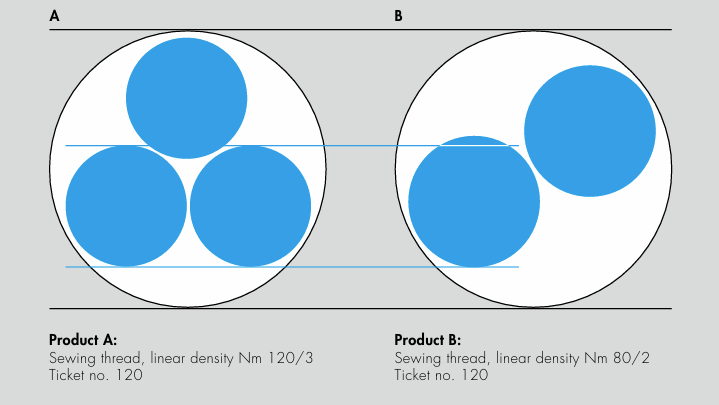
Calculation for example 1:
Product A:
Nm 120/3 = Nm 40 (final linear density);
40 (final linear density) × 3 (historically assumed ply number) = ticket no. 120
Product B:
Nm 80/2 = Nm 40 (final linear density);
40 (final linear density) × 3 (historically assumed ply number) = ticket no. 120
The ticket number is derived by dividing the linear density by the actual number of plies and then multiplying the result by the historical reference ply number (3). This yields the calculated ticket number (120). Both products have the same final linear density and are therefore comparable in terms of strength.
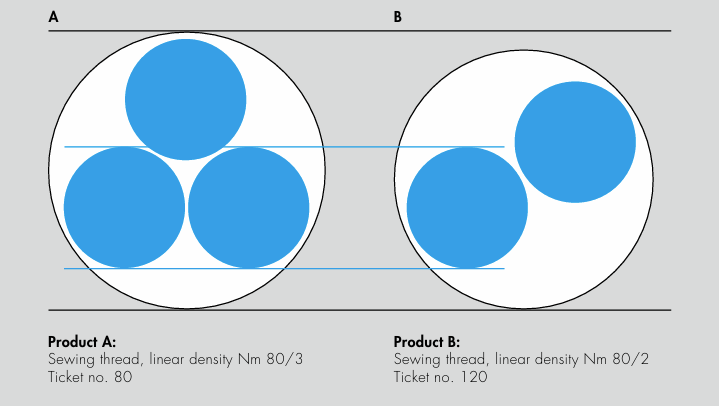
The products have different ticket numbers, despite having the same linear density of their yarns. The reason lies in the different number of plies.
Calculation for example 2:
Product A: Nm 80/3 = Nm 26.6 (final linear density) × 3 = ticket no. 80
Product B: Nm 80/2 = Nm 40 (final linear density) × 3 = ticket no. 120
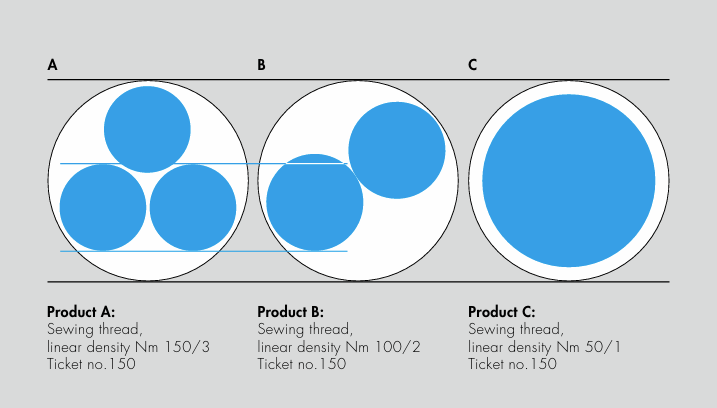
All three products consist of yarns with different linear densities; however, due to the differing thickness of the individual hanks, they have the same final linear density and therefore carry the same ticket number.
Calculation for example 3:
Product A: Nm 150/3 = Nm 50 (final linear density) × 3 = ticket no. 150
Product B: Nm 100/2 = Nm 50 (final linear density) × 3 = ticket no. 150
Product C: Nm 50/1 = Nm 50 (final linear density) × 3 = ticket no. 150
There is no standard or mandatory regulation for the indication of ticket numbers for sewing threads. The labelling system described above is the one commonly used in Europe. In other countries—particularly in Asia—different labelling systems are used. It is essential to know the actual linear density (in Tex or Nm) in order to evaluate thread counts and select the appropriate thread.
Regardless of the raw material, embroidery threads are numbered in accordance with the English cotton fixed-length system NeB. The reason for this lies in their history: mercerised cotton threads were already in use when the first embroidery machines were invented at the end of the 19th century, and they were labelled according to the NeB system. At that time, high-gloss synthetic threads did not yet exist, and silk was too expensive and used only for hand embroidery. As a result, mercerised cotton was the material used for producing glossy threads.
With the emergence of the first synthetic embroidery threads in the mid-20th century, it seemed natural to align the linear density with the cotton system once again. This was mainly because an embroidery design punched card for a 40 yarn could continue to be used with a 40 yarn. A conversion to a different, technically more accurate system was already rejected at that time.
In contrast to sewing threads, however, a 2-ply construction was chosen as the basis for labelling. This is understandable, as almost all embroidery threads are 2-ply constructions. The ticket number for embroidery threads therefore indicates the linear density of the single yarn in NeB.
Example:
An embroidery thread with the linear density ~ NeB 40/2 has the ticket no. 40.
An embroidery thread with the linear density ~ NeB 30/2 has the ticket no. 30.
In contrast to the sewing thread range, the entire embroidery thread range—including polyester, cotton, wool, and metallic qualities - covers only five to six strengths, ranging from 12 to 75.
The most important ticket number is 40, which accounts for an estimated share of more than 80% worldwide.
Because it is often difficult to correctly assign the ticket numbers of embroidery and sewing threads, the following table brings together the most important embroidery thread ticket numbers and the corresponding sewing thread ticket numbers. This comparison is useful when sewing threads are used instead of embroidery threads for embroidery applications.
| Embroidery ticket no. | Cotton ticket no. | Linear density | Corresponsing sewing thread ticket no. |
|---|---|---|---|
| No. 12 | No. 18 | Nm 20/2 | No. 30/35 |
| No. 25/30 | No. 35/45 | Nm 50/2 | No. 75/80 |
| No. 40 | No. 60 | Nm 70/2 | No. 120 |
| No. 50 | No. 75 | Nm 85/2 | No. 140/150 |
| No. 60 | No. 90 | Nm 120/2 | No. 180 |
| No. 75 | No. 112 | Nm 130/2 | No. 220/2/300 |
Running length of sewing and embroidery threads
The running length is often mentioned in connection with sewing and embroidery thread strength. Officially, the running length is not considered a linear density indicator such as Tex or Nm; however, in practice it is frequently used as one.
The running length indicates how many metres of thread weigh 1 kg. Expressed as m/kg, it is closely related to the fixed-length system Nm (m/g). For this reason, the running length is mainly used in Europe, where linear density is expressed in Nm.
As with all fixed-length systems, the following also applies to running length: the higher the ticket number or effective count of a thread, the finer the thread and the greater the running length per unit of weight.
In order to calculate the approximate running length of a thread, the ticket number is divided by 3 and the result is multiplied by 1,000.
Example:
Saba 120 has an approximate running length of 40,000 m/kg.
(Calculation: 120 ÷ 3 = 40; 40 × 1,000 = 40,000).
The effective count should be used to calculate the exact running length of an article. The following formula applies: effective count divided by the number of plies, multiplied by 1,000.
Example:
Saba 120 has an effective count of 72/2 Nm, which corresponds to a running length of 36,000 m/kg
(Calculation: 72 ÷ 2 = 36, 36 × 1,000 = 36,000)
Choosing the right thread size
Besides the raw material and the construction of a sewing thread, its linear density or size also determines its field of application. The size of a sewing thread therefore has a significant influence on both the sewing process and the quality of the seam.
In order to ensure perfect sewability and a trouble-free sewing operation, the sewing thread must be matched to the following factors:
- Sewing material or fabric
- Needle
- Sewing machine
- Seam type
- Stitch type
Sewing tests remain the best method for selecting the appropriate thread size. The sewing material or fabric, as well as the sewing machine, determine the type of needle and the seam and stitch construction, and therefore the suitable sewing thread. Very fine fabrics, for example, require the use of the thinnest needles and sewing threads.
The recommended needle sizes for AMANN sewing and embroidery threads are available on the product pages, as well as in our brochures and colour cards. Depending on the sewing material or fabric and machine type, larger needles may also be required. These should be tested under production-like conditions in advance to avoid any subsequent deterioration in seam quality.
The size of the sewing thread influences seam properties such as cross-breaking strength, elasticity, abrasion resistance, appearance, and handle. Switching to a finer sewing thread to achieve finer seams has noticeable effects on seam strength due to the lower breaking strength of finer threads.
The appearance of prominent decorative seams can only be achieved by selecting a coarser sewing thread. The correct needle size for the respective fabric should always be determined in advance through testing. Depending on the structure of the outer fabric, damage may occur if a needle that is too large is used (fabric or mesh damage).